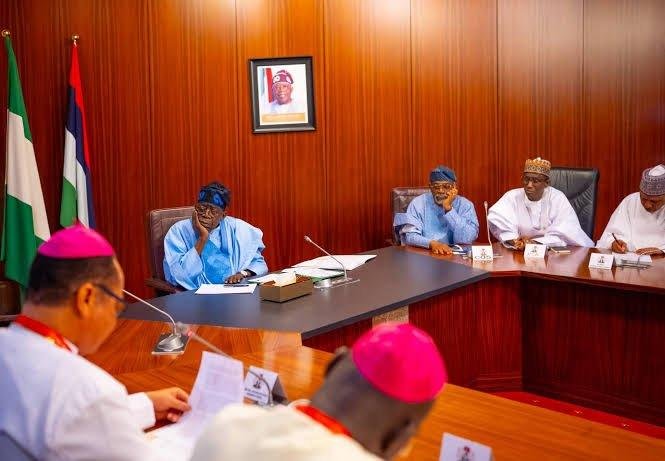
When His Eminence, John Cardinal Onaiyekan, Archbishop Emeritus of Abuja, and other members of the Catholic Bishops’ Conference of Nigeria (CBCN) addressed the press following their meeting with the President of Nigeria, they did so from a place of genuine concern and deep worry about the state of the nation.
The carefully curated responses and sound bites released by the Presidency and its media handlers appeared designed to trivialise what remains an existential concern for the majority of Nigerians: the near total breakdown of law and order and the severe economic hardship imposed on citizens by the policies of this administration.
By addressing the press, Cardinal Onaiyekan and the CBCN sought to do one simple but important thing: place before Nigerians the full substance of what they told the President. That is not an act of hostility. It is a moral responsibility they owe to the people, particularly when their intervention is motivated by concern for the wellbeing of the country.
The response from the Presidency and its operatives, however, revealed a barely concealed contempt for those who refuse to unquestioningly endorse its position. The insults and name-calling that followed, culminating in the circulation of a purported response from a supposedly Catholic youth organisation that does not appear to exist, exposed an unfortunate mindset within the administration.
If left unchecked, such an approach creates the impression that opposing views are not to be tolerated, much less encouraged. The attacks on the person of Cardinal Onaiyekan and the CBCN by extension, raise serious questions about the administration’s respect for the Church, its leadership and the values for which the Church stands.
Considering the President’s much-touted democratic credentials, one is compelled to ask whether the meaning of democracy, freedom of speech and freedom of expression has somehow changed in the three years since this administration came to power.
Religious leaders such as Cardinal Onaiyekan represent an important part of the moral conscience of our society. Their interventions, particularly when directed at issues affecting the welfare and security of citizens, deserve to be treated with seriousness and respect. Disagreement is perfectly legitimate in a democracy; personal attacks and attempts at intimidation are not.
This is one area where the Atiku–Amaechi combination stands apart.
Alhaji Atiku Abubakar, even as a Muslim, has consistently demonstrated respect for religious authorities, whether they belong to the Islamic or Christian faith. His responses to criticism have been measured and respectful, driven by his firm belief that robust political disagreement should never become an excuse to disrespect institutions of faith or attack individuals simply for expressing an inconvenient opinion.
Chibuike Rotimi Amaechi, on the other hand, is a Papal Knight of the Roman Catholic Church. Papal knighthood represents one of the highest recognitions the Catholic Church can confer on a layperson. Yet beyond the title, there is a more personal and telling example of his approach to religious tolerance. Visitors to his home have observed that Muslims have a dedicated space for prayer.
That simple gesture says much about his understanding of religious coexistence. It reflects a recognition that having Muslims among his personal staff does not and should not prevent them from observing one of the fundamental obligations of their faith — the five daily prayers. It is consistent with the deeply respected traditional title of Dan Amanar Daura.
For both men, constructive criticism, such as the kind offered by Cardinal Onaiyekan, should be welcomed.
It provides an opportunity to listen, reflect, and present a different perspective while acknowledging mistakes and making corrections where necessary, because democracy is strengthened rather than weakened when citizens are free to speak.
It is not an invitation to demonstrate that one possesses all the answers or to behave as though disagreement is evidence of ignorance or disloyalty.
That is the mindset they intend to bring to government.
In a country as diverse as Nigeria with its multi-ethnic, multi-religious and politically complex system, mutual respect and understanding are not luxuries. They are necessities.
Government must be able to engage with citizens who disagree with it without treating criticism as an act of rebellion.
With the Atiku–Amaechi team, Nigerians should be assured that holding a different opinion, questioning government policy or legitimately complaining about the consequences of those policies will not automatically invite personal attacks.
Instead, disagreement should create an opportunity for engagement. Criticism should invite dialogue.
Concerns should be heard.
And when government gets something wrong, there should be the humility to acknowledge it and make corrections.
That is the essence of democratic governance.
Nigeria does not need a government that believes it is always right. It needs a government confident enough to listen, humble enough to learn and responsible enough to put the welfare of Nigerians above the protection of its own image.
That is the spirit the Atiku–Amaechi team says it is bringing to government: a government that listens to its people, respects their institutions and faiths, welcomes constructive criticism, and understands that democracy is strengthened, not weakened when citizens are free to speak.
—
← All blogs & analysis