Nations do not collapse in a single dramatic moment. They decline gradually. First, citizens lose faith in institutions. Then they lose faith in leadership. Eventually, they begin to lose faith in the very possibility of change. The danger is not merely economic hardship or political instability. The greater danger is the normalisation of both.
That is the crossroads at which Nigeria finds itself today.
Across the country, there is a growing sense that government has become disconnected from the realities of ordinary people; that politics has become more concerned with retaining power than exercising it responsibly; and that public office is increasingly measured by political loyalty rather than performance.
In such circumstances, elections can no longer be approached as exercises in sentiment. They become exercises in national judgement.
The question before Nigerians is therefore not who comes from where, who belongs to which faith, or whose turn it is to occupy Aso Rock. The more important question is which leadership team possesses the experience, competence and governing capacity to arrest decline, restore confidence and move the country forward.
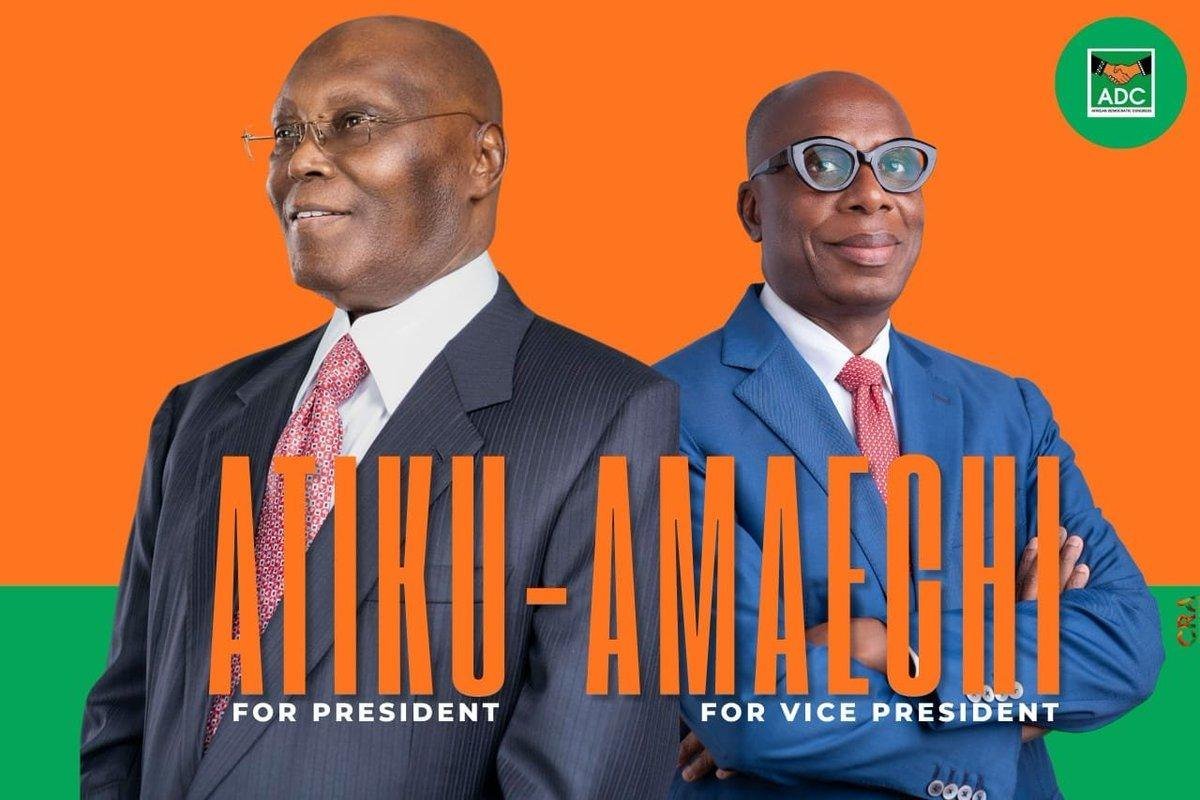
It is within this context that the emerging Atiku Abubakar–Rotimi Amaechi ticket of the African Democratic Congress deserves serious reflection, not partisan dismissal.
Politics, after all, is ultimately about assembling the broadest coalition of experience, ideas and national reach. The strongest tickets in democratic history are rarely those built around sentiment. They are often those that successfully combine strategic vision with administrative capacity, political reach with executive competence, and national appeal with institutional knowledge.
The Atiku–Amaechi pairing arguably possesses these qualities in abundance.
For more than three decades, Atiku Abubakar has remained one of the most consequential figures in Nigeria's democratic journey. Whether one agrees with him politically or not, few can dispute his longevity, resilience and enduring relevance. He has traversed virtually every phase of the Fourth Republic. He was a principal architect of Nigeria's democratic transition, served as Vice President during one of the country's most reform-oriented administrations and has remained a persistent advocate of restructuring, economic liberalisation and private-sector-led growth.
His greatest political asset is not merely his popularity in the North. It is his understanding of the Nigerian federation.
Atiku has spent decades building political relationships across every region of the country. He understands the complexities of managing Nigeria's diverse interests because he has lived through virtually every major political realignment since 1999. At a time when the country faces profound economic and constitutional questions, institutional memory is not a liability. It is an asset.
Yet leadership in modern governance cannot rely solely on experience. It must also be complemented by demonstrable executive capacity and a proven track record to deliver.
That is where Rotimi Amaechi enters the equation.
Few contemporary Nigerian politicians possess a public service record as extensive and as measurable as Amaechi's. Before becoming Minister of Transportation, he served as Speaker of the Rivers State House of Assembly and later as a two-term Governor of Rivers State. His years in public office produced a reputation—admired by supporters and acknowledged even by critics—for relentless focus on execution and results.
The ADC itself cited this breadth of experience in explaining his selection as Atiku's running mate following the party's primary contest.
Amaechi represents a leadership tradition that is increasingly scarce in Nigerian politics: governance measured by outcomes rather than rhetoric or the weaponisation of ethic or religious sentiments.
His tenure in Rivers State transformed infrastructure, education and public administration. As Minister of Transportation, he became associated with some of the most ambitious railway transport and security infrastructure projects undertaken in recent decades. Whether one agrees with every policy decision or not, there was never any ambiguity about his governing philosophy. He believed government existed to deliver and deliver he did, even the ruling APC can not deny that, as they even intend to use projects initiated and executed by him to campaign.
Nigeria today suffers not merely from a deficit of ideas but from a deficit of implementation. Policies are announced with great fanfare, committees are inaugurated, white papers are produced, yet execution remains painfully weak and in most cases untenable. The challenge facing the next administration will not simply be designing reforms. It will be implementing them.
Amaechi's value to any ticket lies precisely in that capacity and not even the opponents of the ADC can argue with that.
What makes the Atiku–Amaechi combination particularly compelling is that it emerges not from political convenience but from political competition.
Amaechi did not arrive on the ticket as a passive beneficiary of elite negotiations. He contested the ADC presidential primary and lost to Atiku. Reports indicate that he emerged after extensive consultations.
That distinction is important.
Democracy is strengthened when rivals become partners after competition. It demonstrates political maturity. It signals that ambition can be subordinated to collective purpose. More importantly, it sends a message that leadership is not always about personal victory but about national contribution.
In many ways, Amaechi's acceptance of the vice-presidential slot may ultimately enhance rather than diminish his political stature. It portrays him as a statesman willing to place coalition-building above personal aspiration, and any feeling of dissatisfaction, regardless of how valid or otherwise it may seem.
For the ADC, the ticket also solves a strategic problem that has plagued opposition politics for years.
Nigerian elections are rarely won through regional dominance alone. They require broad national coalitions capable of transcending traditional political boundaries. Atiku brings deep roots in the North and extensive national networks. Amaechi brings significant influence in the South-South, and an acceptability in North that few politicians in the south can boast of, as well as credibility among reform-minded voters and a reputation for administrative toughness.
Together, they create a genuinely national ticket.
But beyond electoral arithmetic lies an even more significant consideration.
The Nigerian opposition has often struggled because it has been unable to reconcile competing ambitions into a coherent governing alternative. Coalitions collapse under the weight of egos. Alliances fracture before reaching the electorate. The willingness of Atiku and Amaechi to work together after a competitive primary offers evidence that a different political culture can indeed be our reality.
Critics will undoubtedly point to Atiku's multiple presidential bids. Others will question Amaechi's often combative political style or his decision, once again, to align himself with a northern presidential candidate. These are legitimate observations and, in a healthy democracy, they deserve consideration.
Yet the more important question is whether Nigerians can honestly say they are satisfied with the current state of the nation.
Has the promise of a southern presidency translated into greater national cohesion, broader inclusion or a better quality of life for ordinary citizens? Or has the country become more divided, democratic institutions increasingly abused, the opposition subjected to growing pressure, and the economic burden on citizens made even heavier?
This is a moment when millions of Nigerians are less concerned about political symbolism than about their daily survival, hence elections cannot be reduced to arguments about geography, ethnicity or whose turn it is to govern. They must instead be determined by a sober and comparative assessment of the competing tickets, their records, their capacity and their vision for the country. This, ultimately, is the standard by which every presidential ticket seeking the confidence of Nigerians should be evaluated.
And when Nigerians evaluate potential leadership teams, they must ask difficult but necessary questions. Which ticket possesses the greatest combined executive experience? Which ticket has managed large public institutions? Which ticket understands both the mechanics of governance and the realities of electoral politics at a National scale and can deliver results? Which ticket can immediately assume responsibility for a nation confronting economic uncertainty, insecurity and institutional decline? All answers must be drawn from their track record
The Atiku–Amaechi partnership provides persuasive answers to those questions.
Indeed, the greatest strength of the ticket may not lie in either man individually but in the complementarity of their strengths. Atiku brings strategic vision, economic orientation and national political reach. Amaechi brings operational discipline, administrative experience and a proven record of execution. One represents political breadth; the other embodies governmental and administrative depth, and any successful government would require both.
As Nigeria approaches another defining electoral cycle, voters will eventually have to decide whether they prefer symbolism or substance, slogans or governance, sentiment or competence, the turn by turn approach or a chance at really turning things around.
The Atiku–Amaechi ticket is not being presented as a perfect answer to Nigeria's challenges. No democratic ticket can honestly make such a claim. What it offers instead is something perhaps more valuable: a combination of experience, tested leadership on a National scale and administrative capacity assembled at a moment when the Nigerian state desperately needs all three.
For the ADC, it is the strongest ticket available; for the collective opposition, it is the most credible route to power and for Nigerians, this ticket presents an opportunity to place proven governance experience at scale back at the centre of national leadership.
History will render its verdict. But from every serious political and governance standpoint, the Atiku–Amaechi pairing deserves to be regarded not merely as an electoral arrangement, but as the most consequential political partnerships currently available to the Nigerian electorate in 2027.
—
← All blogs & analysis